LOCAL PERSPECTIVE
The short version
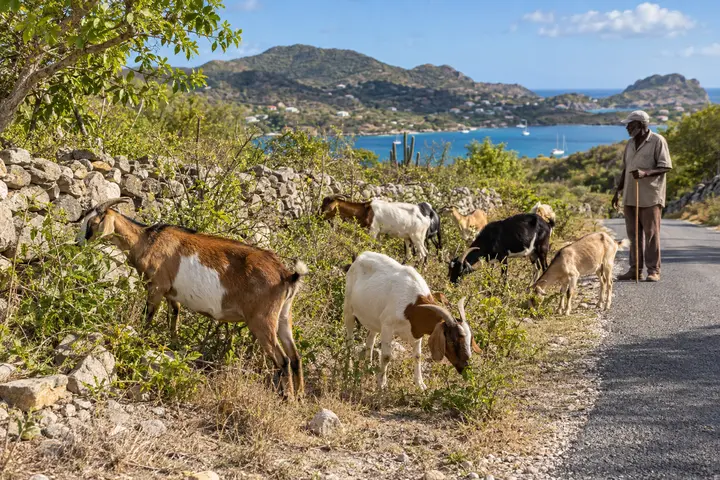
Goats seen near roads or open land are often owned even when no fence is visible. Their visibility reflects grazing practices, hardy livestock and Antigua’s dry landscape—not a population of ownerless roadside pets.
Roaming does not mean ownerless
A goat may range beyond a yard and still be recognised by an owner or community. Identification and grazing practices are not always obvious to visitors. Do not assume an animal can be handled, moved, adopted or fed simply because it is outside a conventional fenced pasture.
Why goats suit Antigua’s climate
Antigua is relatively dry compared with some Caribbean islands. Goats tolerate heat and can browse shrubs, leaves and tough vegetation that other livestock may avoid. Their hardiness makes them useful in landscapes where rainfall and pasture quality vary, although overgrazing can damage vegetation and contribute to erosion.
Land use makes animals more visible
Open plots, former estate land, village edges and unfenced areas create movement corridors that look unusual to visitors from highly suburban places. A road may cut through a familiar grazing area. The goats did not necessarily “escape” in the dramatic sense; the local boundary between road and range may simply be less formal.
Road safety around livestock
Slow down when goats, sheep, cattle or donkeys are near the road. Young animals can change direction suddenly, and a horn does not guarantee they will move away. Avoid swerving into oncoming traffic. At night, reduce speed in areas where animals are commonly seen.
Why feeding is a bad idea
Food encourages animals to approach vehicles and people, changes normal behaviour and may be unhealthy. It can also create conflict with owners. A photograph taken from a safe distance is enough; do not place food near the road or attempt to arrange the herd for social media.
What goats reveal about the island
They connect modern Antigua with small-scale livestock keeping, dry-season adaptation and a landscape where village, scrub and road overlap. Seeing them as part of a working environment—rather than a quirky attraction—produces a more accurate and respectful understanding of rural island life.
A NOTE ON PERSPECTIVE
No single voice represents every Antiguan.
This guide reflects local experience and careful review, but communities, households and generations differ. Where a subject deserves several voices, treat this as a starting point rather than the final word.